
Root touch-up
Best when regrowth or gray coverage is the main issue.
Hair color in Venice, FL
5.0 ★ from 100+ Google reviews · 30 years · 15,000 clients · Master Cosmetologist
Hair color that looks intentional, not guessed.
Looking for hair color near you in Venice, FL? Single process, root touch-up, gray coverage, foil highlights, lowlights, balayage, foilayage, babylights, gloss or toner, and lived-in color planning with Scott Farmer, Schwarzkopf-certified master colorist. Schwarzkopf low-ammonia formulas custom-blended per client, glaze or toner included on every dimensional service.
Color services from $80-$250 · 45 minutes to 2 hours · Currently booking 2 to 3 weeks out
Two-Week Sit-Right Guarantee. If the cut or color does not sit right within two weeks, contact me. I will fix it free.
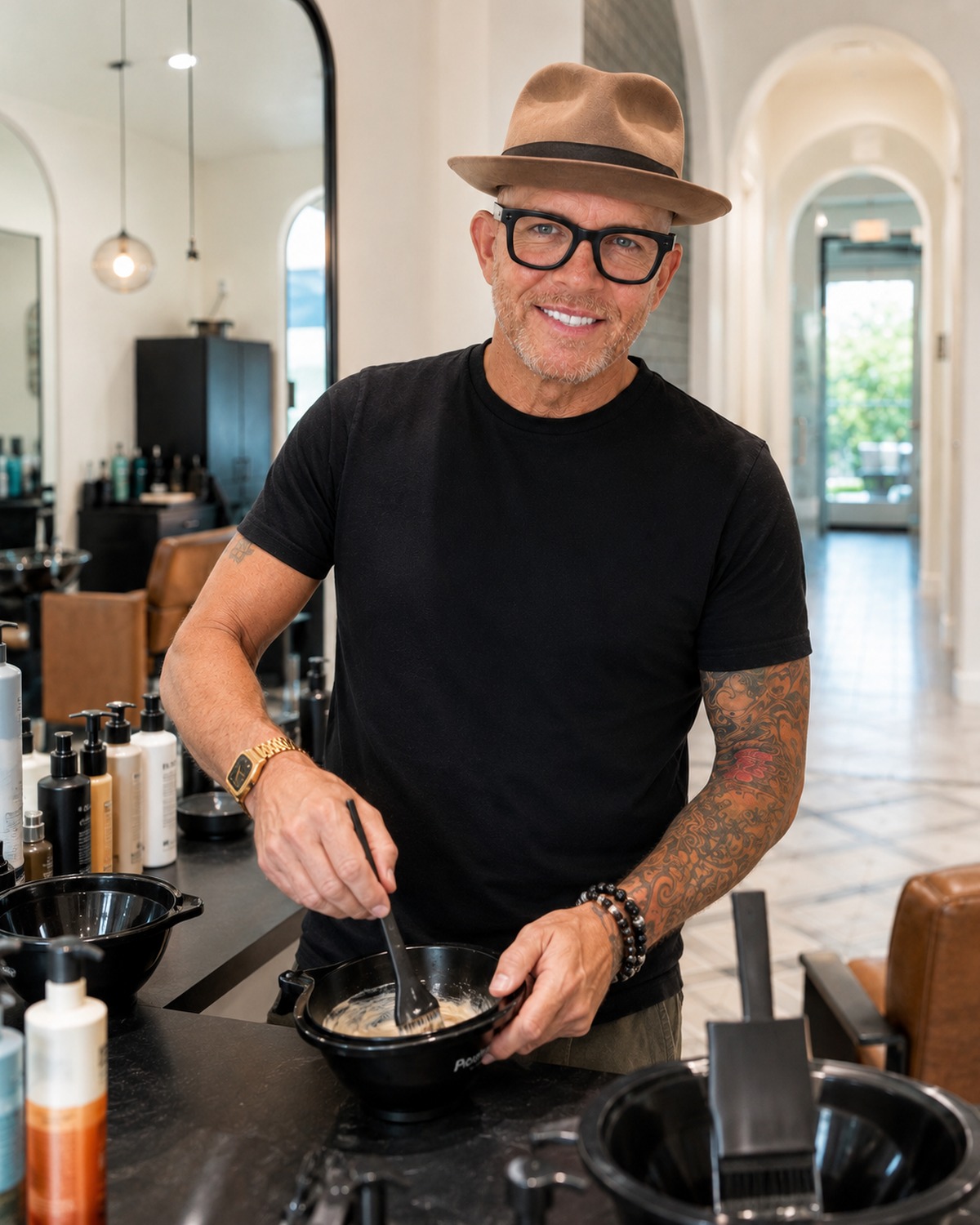
The method
Before any color, foil, or shears, I run the Pre-Cut Read™: density, growth pattern, porosity, lifestyle fit, and what the last three stylists missed.
Three minutes of looking saves six weeks of fixing.
Every appointment starts here.
Choose with confidence
Quick decision guide
Best when regrowth or gray coverage is the main issue.
Book a gloss when shine, warmth, brassiness, or faded tone needs refinement.
Best when the goal needs color, lightness, and placement planned together.
Pricing and timing
Scott starts with your color history, current condition, and goal photos before choosing the formula. Master cosmetologist, Schwarzkopf-trained colorist, 30+ years behind the chair. I use bond builder protection (Schwarzkopf Fibreplex) in every lift session. Blondes, brunettes, redheads, and grow-out blends are all formulated to base, porosity, and goal.
Color melt and root tap finishing for soft grow-outs. Shades Scott mixes most often: honey, caramel, copper, ash blonde, beige blonde, mushroom brown, espresso, chestnut, auburn, strawberry blonde, soft platinum. I factor Florida humidity and saltwater into every formula so the tone holds in coastal heat. Color is 60% of what I do, and great hair color compliments a great haircut.
The two-week guarantee. If the cut or color does not sit right within two weeks, contact me. I will fix it free.
| Service | Time | Price |
|---|---|---|
| Single Process Color / Root Touch Up | 1 hr | $125 |
| Color Gloss stand-alone | 45 mins | $80 |
| Color Gloss and Blow Out | 1 hr 15 mins | $140 |
| Tint Back Color | 2 hrs | $250 |
Before you book
Single process color or root touch up is $125. Gloss stand-alone is $80. Gloss with blow out is $140. Tint back to natural is $250. I publish fixed prices. No surprise upcharges at checkout.
Single process is about 1 hour. Gloss is 45 minutes. Tint back to natural is about 2 hours. Bigger corrections take longer and are quoted at consultation.
Schwarzkopf professional color throughout. Custom-formulated per client in the suite. Scott is also Paul Mitchell and Tigi certified, but Schwarzkopf is the primary color line.
Yes. Single process root touch-up at $125 covers gray fully. For gray blending instead of full coverage, Scott can plan dimensional placement that softens the line without full opacity.
Modern Schwarzkopf formulas with bond builder minimize the impact. I check porosity and condition during the Pre-Cut Read before I choose the formula. If the hair is already compromised, I will say so and recommend a gentler approach.
Book color for root coverage, gray coverage, gloss, toner, or an all-over shift. Book highlights when the main goal is controlled brightness or dimension.
Yes. Old permanent color, box dye, and banding can change the timing and result. Call or text first if that applies. For heavy box dye history, color correction comes first.
Not offered here: extensions, perms, keratin smoothing, lash, wax, bridal updos, kids under 12. Cut, color, balayage, foil highlights, and correction only.
Find the salon
Inside Phenix Salon Suites. Free parking on site.
People also ask
Most colorists in Venice will say yes to your service whether it is right for you or not. They are not lying. They are guessing. I get it. After 30+ years and 15,000+ clients, I read your hair, your history, and your tone goal first, then tell you straight which service gets you there. Single process from $125. Balayage from $210. Custom Schwarzkopf formula every visit. 5.0 from 104+ Google reviews.
Hair Color Venice FL, done by me
30 years. 15,000+ heads. Every appointment runs through what I call The Color Map: three reads before a tool touches your hair. That is why my work holds tone, why your grow-out reads natural, and why my chair sits at 5.0 across 104+ Google reviews.
I check how thirsty your hair is at the mid-shaft before I mix. Thirsty hair grabs pigment cold and pulls warm in week two.
Old box dye, henna, a previous correction. I would rather know now than discover it at the rinse.
Gray coverage, dimensional brightness, going darker. Each one is a different formula. We agree on the goal first.
Scott uses Schwarzkopf professional color for single-process color, gray coverage, dimensional color, and gloss / toner services. Every formula is mixed for your specific starting condition. That includes hair history, porosity, the previous color in the ends, and the tone you actually want to leave with: not a generic shade card pulled off the wall.
For dimensional color, custom toner blending is what makes the difference between “the color looks fine” and “the color is exactly right.” Color and tone are planned together at the consultation so the result still reads correctly two weeks after the appointment.
Root touch-ups for gray coverage are timed and formulated to age cleanly between visits. The factors that change how long a single-process color lasts: how much gray is present, the contrast between your hair and the gray, hair texture, and how often you wash.
If gray coverage has felt like a losing battle: washes out fast, looks brassy, or shows root demarcation within three weeks: start with a consultation. Scott will check whether the formula, application, or maintenance plan is what needs adjusting before booking a longer service.
If your hair has a record of box dye, semi-permanent gloss, henna, or any uneven color through the ends, mention it before booking. That history changes whether a single-process color is enough, or whether the appointment needs to be planned as a corrective color service instead. A 10-minute pre-appointment call or text usually answers the question.
Single Process Color: $125. Color Gloss stand-alone: $80. Color Gloss + Blow Out: $140. Tint Back: $250. Published starting prices: long, very thick or previously color-treated hair may need additional product time. Scott will tell you at the consultation, not after.
The color is Schwarzkopf, mixed for your hair, not pulled off a shade card. Scott looks at the history first. What box dye is hiding in the ends. How porous the mid-lengths are. Where the previous color has banded. What you actually want to walk out looking like.
Then the formula. Single-process color is $125. Gloss is $80 on its own, $140 with a blow-out. Tint-back is $250. Color correction is quoted at the consultation because that one really depends on what we’re fixing.
Single process color: see the full Single Process Color in Venice FL guide with the 3-Read Color Map, the decision table for when to book it, and the $125 / 1-hour pricing.
Pick the right service
Here is the deal. Most salons quietly oversell the service the client walks in asking for. I do not. I will point you to the right service even when it is not the one you came in for.
| You are here | Book this | Why |
|---|---|---|
| Gray winning at the part line | Single process $125 | Full gray coverage in one application |
| Just need root maintenance | Root touch up $125 | Only the regrowth, one hour |
| Want soft sun-kissed brightness | Partial or full balayage | Hand-painted, soft grow-out |
| Want defined bright highlights | Foil highlights from $125 | Woven foils, controlled brightness |
| Want maximum lift on dark hair | Foilayage from $225 | Foil-sealed balayage for stronger lift |
| Last color went wrong somewhere | Free color correction consult | I will plan it across visits if needed |
Not sure which row is you? Text me a photo at 941-599-4868. I will tell you the right service before you book.
Last updated August 2026 by Scott Farmer, master hair stylist, Venice FL.
Cuts and color by appointment in a private suite in Venice. Online booking shows real-time openings. For corrections, big changes, or anything you are not sure how to book, text or call Scott directly.
New clients book two to three weeks out. Color corrections book four weeks out.
The next available chair is the one that plans first. (941) 599-4868